Why production schedules fail: the Smart Kanban experience in Cehovik ERP
I started with the idea of a full APS and a detailed schedule for every operation. In practice, small and medium-sized manufacturers usually need a different path: a simple manageable queue, current shop-floor facts, and planning that becomes more sophisticated one step at a time.

A company has orders, people, work centers, and equipment. Yet no one can answer three simple questions with confidence: which order should be worked on next, who exactly should do it, and whether the required people, materials, and capacity are available.
Production planning already exists at that point. It is simply spread across Excel, a whiteboard, messenger chats, and the production manager's memory. Everyone knows one part of the picture. No one sees the whole thing.
We saw this repeatedly while developing Cehovik ERP. The order has been accepted, the customer has been given a date, and production is busy. But the system cannot explain why one order is stuck, another suddenly became urgent, and a third jumped the queue. Often, neither can a person.
More detail does not fix chaos
A manager's first natural reaction is to build a detailed schedule. Break every order into operations, assign a machine and an employee, and set start and finish times. The result is a beautiful Gantt chart.
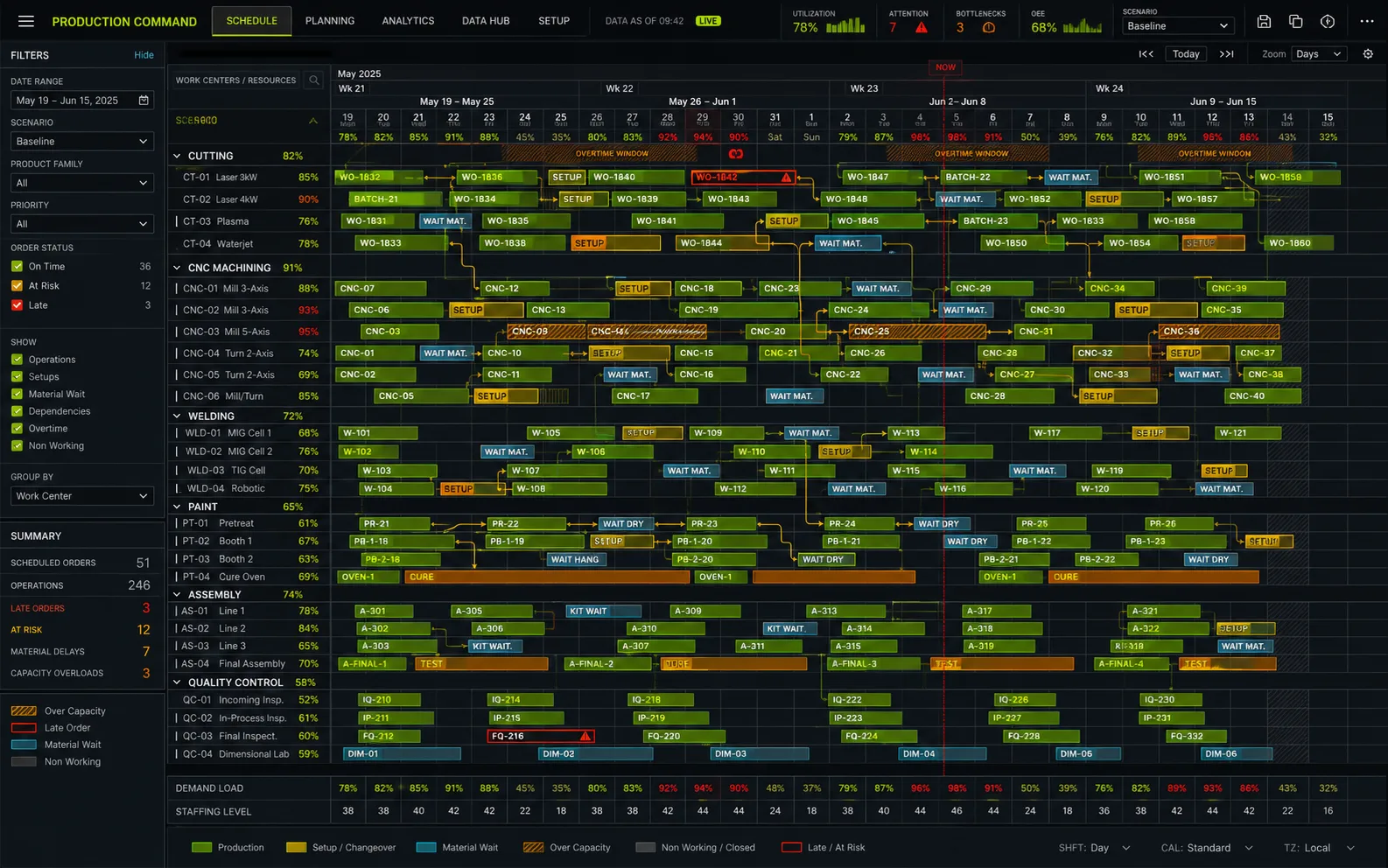
The chart itself is not the problem. It is a good way to show a plan. The problem begins when a person has to maintain every change manually.
An urgent order arrives. A material delivery is late. An operator is absent. A machine stops. The previous operation took five hours instead of two. After every such event, the dispatcher has to move more than one bar and recalculate the impact on every operation that follows.
Very quickly, the dispatcher stops managing production and starts servicing the chart. The shop floor keeps moving in the meantime.
Why I first looked toward APS
For a long time, I believed the right answer to this problem already existed. It was a full APS system at the level of Siemens Preactor, which is now developed as Opcenter APS.
The logic is convincing. APS accounts for finite capacity and the availability of equipment, people, tools, and materials. The system knows the technological constraints, order priorities, and changeovers. An algorithm then builds a detailed feasible schedule.
For complex manufacturing with stable processes, reliable data, and a dedicated dispatching function, this is a powerful tool. I still do not consider APS a bad approach.
But Cehovik serves a different audience: small and medium-sized manufacturers. They often do not have a dedicated dispatcher who watches the model all day. Standard times are still being collected. Some decisions depend on the supervisor's experience. Actual operation completion is recorded late or not recorded at all.
We tried different options and found an uncomfortable pattern. The more detailed the ideal plan became, the harder it was to make the company actually work by it. The system demanded more data and control than the organization could provide consistently.
We ended up with an expensive mirror showing yesterday's factory.
What we called Smart Kanban
We eventually arrived at a method that we called Smart Kanban inside Cehovik ERP.
It is not merely a board with cards, and it is not an attempt to hide a full APS behind a fashionable interface. The point is different: the system handles routine queue management without requiring the company to describe its factory as precisely as a digital twin from day one.
This is how it works:
- A production order is broken down into operations and work centers.
- The system understands which operations are ready and which must wait for a previous step.
- The customer order priority affects the work sequence.
- Available operations are assigned to suitable work centers according to their capacity.
- A manager can pin a deliberate exception. For example, a specific operation can stay in a chosen position and remain unaffected by automatic rescheduling.
- Completed operations return actual data to the system and update the current picture.
An operator does not need to understand the entire production plan. They see the queue for their work center and know which available operation to take next. A manager sees where a work center is overloaded, where capacity is idle, and which order risks missing its date.
Smart in this name does not mean AI. The board does more than display cards. It accounts for operation readiness, priorities, and available capacity, then rearranges the unpinned part of the queue. People handle exceptions instead of manually moving the entire factory.
Why this approach proved more viable
APS tries to create a consistent plan from a complete model of constraints. Smart Kanban answers a more practical question: of the work that is actually available, what should be done next?
For a small manufacturer, that question is often more valuable than a perfect schedule several weeks into the future.
The method can be introduced gradually. First, the company learns to see orders and operations. Then actual completion data appears. Standard times, work-center calendars, priorities, and forecasts can be added afterward. Each new layer rests on the previous one, which is already working.
Another difference is the number of manual decisions. If an exception genuinely matters, a manager intervenes. Normal production flow does not require the schedule to be redrawn constantly.
Most importantly, an employee can understand a queue of available operations more easily than a complex model of the entire company. The system starts being used not only in the planning meeting but also on the shop floor. That is the moment when planning finally becomes a working process.
A plan can only calculate with the data it receives
A company can buy a powerful system, configure a sophisticated algorithm, and still fail to achieve working production planning.
If an operator finishes an operation but does not record it, the system believes the work is still in progress. If material arrives but the storekeeper does not register the receipt, that material does not exist for the system. If a machine stops while its calendar remains unchanged, the algorithm continues loading capacity that is not there.
The calculation is not wrong. It is accurately planning a fictional factory.
This is why planning quality does not begin with the algorithm. It begins with a management agreement about who records production facts, when they do it, and how.
I have already written about this in the context of MES and shop-floor data. The first goal is to make sure the actual state of production reaches the system on time. Only then does it make sense to demand an accurate forecast.
In practice, I would proceed like this:
- Enter real orders and operation sequences.
- Teach operators to record operation starts and completions on time.
- Add warehouse facts: receipts, issues, and material shortages.
- Gradually collect standard times and current work-center calendars.
- Configure priorities, queues, and exception rules.
- After enough data has accumulated, move to due-date forecasting and more advanced optimization.
Trying to switch everything on at once usually ends with people returning to Excel and chat. This is not necessarily resistance to digitalization. The new system simply asks for too many new actions before it begins to help.
Where AI will enter production planning
AI will not remove this sequence. It will make the quality of actual data even more important.
AI can already be used alongside a planning system in several practical scenarios:
- find missing statuses and contradictions in data;
- forecast operation duration and due-date risk from accumulated history;
- suggest a priority change after a new order, equipment downtime, or a delayed material delivery;
- explain why an overload appeared and show possible redistribution options;
- extract constraints and operations from route sheets and text descriptions for subsequent human review.
For now, I would not give AI the authority to rebuild the entire production plan autonomously. A more realistic near-term role is that of a dispatcher's assistant. It detects a deviation, prepares several scenarios, shows the consequences, and explains the trade-off in plain language. The decision remains with a person.
The next stage is more interesting. AI will be able to learn from the actual deviations of a specific company. Instead of simply accepting a two-hour standard, it can see that this operation, at this work center, for this type of order usually takes a different amount of time. Instead of rearranging cards by a formal priority alone, it can detect the chain that will lead to a missed date.
These approaches are already being studied in dynamic scheduling and manufacturing simulation. Yet even the smartest algorithm runs into the old problem. If the company does not know what is happening to an order, material, operator, and machine right now, AI will not know either.
Where I would start today
I would not start with a competition between algorithms, and I would not try to build the perfect plan for the entire company at once.
My advice to a small or medium-sized manufacturer is simple: do not invent your own dispatching system. Follow a proven path with a gradual implementation of Cehovik ERP and Smart Kanban. Start by making orders, operations, and the queue visible. Then establish timely recording of actual progress. After that, add standard times, capacity, forecasts, and more sophisticated rules.
Planning starts working not when a system can calculate everything, but when people on the shop floor can take the next understandable step and a manager can see the consequences.
Smart Kanban provides that level of control today. Once shop-floor data begins returning regularly, future AI planning finally has something real to work with.
Facing something similar?
Tell me what your processes look like today — I’ll say whether it is worth automating and where to start.
Get in touch